
The book range assumes a commute you don't have
Open an owner's manual and brake pad life is usually quoted somewhere in the 30,000-70,000 mile range. That range assumes mixed driving: some highway cruising, some city stops. A Hayward commute is not mixed driving. It is creeping traffic on I-880, signal after signal on Mission Boulevard, and a hill in almost every direction. Each of those wears brakes in its own way, and together they can push pad life to the bottom of the printed range or below it.
Here is what these roads actually do to pads and rotors, the warning signs worth acting on, and what realistic replacement intervals look like for drivers who run these routes every day.
Stop-and-go on I-880 does the slow, steady damage
The Nimitz between Hayward and Oakland is one of the most congested stretches of freeway in the East Bay. On a clear road you might touch the brakes a handful of times over ten miles. In a crawling commute you can brake dozens of times over the same distance: creep, stop, creep, stop, from the 92 interchange past A Street and on toward San Leandro.
Every one of those stops scrubs a thin layer of friction material off the pads. None of them is hard braking, so drivers rarely notice, but the count is what matters. Braking converts speed into heat, and in dense traffic the system never gets a stretch of open road to cool before the next stop. Front brakes also carry most of the load when a car pitches forward under braking, often two thirds or more of the stopping force, which is why front pads on a daily 880 commuter almost always wear out first.
The grades on 238 and the hills add the heat
Stop-and-go wears pads gradually. Grades build heat, and heat is what damages the rest of the system. Route 238 runs along the base of the Hayward hills, and its Foothill Boulevard stretch slopes down from the I-580 interchange at Castro Valley into downtown Hayward. Drivers coming off westbound 580 have often just come down the long grade into Castro Valley as well, so their brakes arrive at the bottom already warm.
The surface streets are steeper. Coming down from the Cal State East Bay campus on Harder Road or Carlos Bee Boulevard, or dropping out of the canyons on Redwood Road or Crow Canyon Road into Castro Valley, a driver who rides the pedal the whole way down heats pads and rotors far beyond what ordinary city braking produces.
Sustained heat does three things. It can glaze pads, hardening the friction surface so it grips less. It can heat rotors unevenly, which you later feel as pulsing in the pedal. And over time it degrades brake fluid, which makes the pedal feel soft. The fix on the hills is simple: shift to a lower gear and let the engine hold your speed, then brake firmly in short applications instead of dragging the pedal for the whole descent.
What that does to pads and rotors
New pads carry roughly 10 to 12 millimeters of friction material. Constant low-speed stops wear that material down steadily. Hill heat adds damage on top: glazing, tapered wear when a caliper starts to stick, and in bad cases cracked friction material.
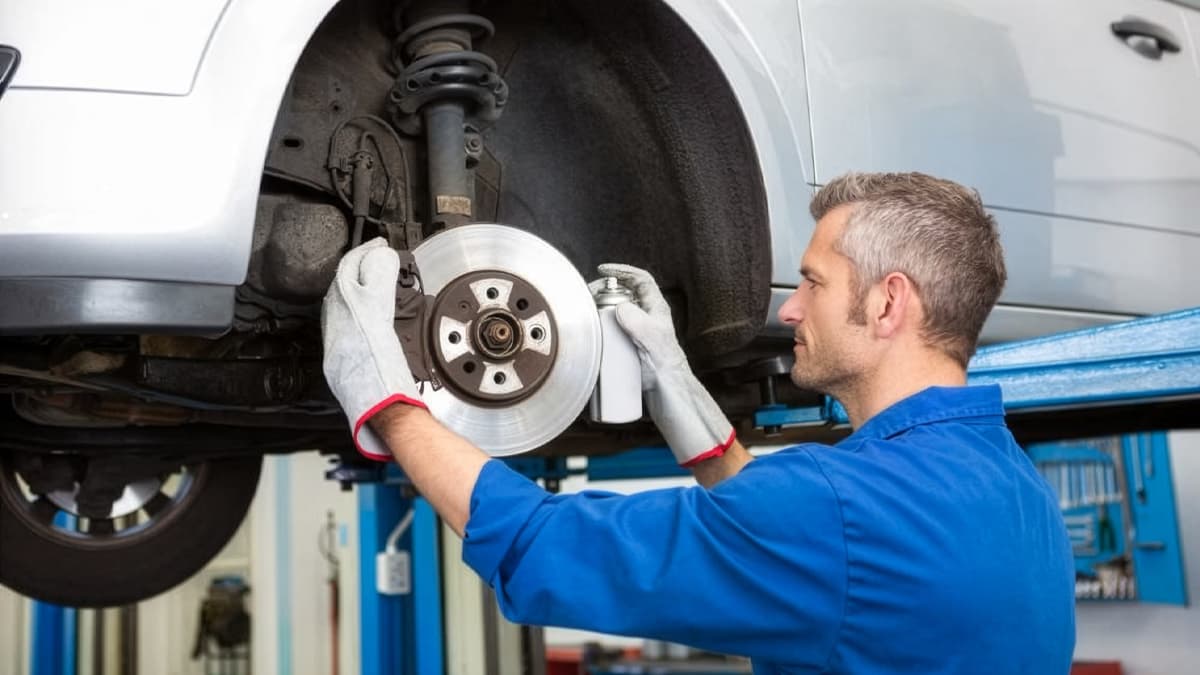
Rotors suffer differently. Repeated heat cycles can create thickness variation and hard spots on the rotor face, which is the usual cause of steering wheel shake under braking. And once pads wear down to the metal backing plate, that plate cuts grooves into the rotor face within a few miles of driving. That is the difference between replacing pads and replacing pads plus rotors, and rotors are the expensive part. Rotors also have a minimum thickness spec, so one that is scored or worn thin usually has to be replaced rather than machined.
Warning signs, in order of urgency
A high-pitched squeal when braking is usually the built-in wear indicator, a small metal tab designed to touch the rotor when the pad is nearly used up, typically around 2 to 3 millimeters of material left. It means schedule an inspection soon, not that the car is unsafe today.
Grinding is different. A grinding or growling sound under braking usually means the friction material is gone and metal is contacting the rotor. Every stop is doing damage at that point, and stopping power suffers. Get it looked at right away.
Three more signs worth acting on: vibration or pulsing in the pedal or steering wheel when braking, which usually points to rotor thickness variation. A pedal that feels soft or travels lower than it used to, which signals a fluid or hydraulic problem and needs immediate attention. And stops that simply take longer, or a car that pulls to one side while braking, which often traces back to uneven pad wear or a sticking caliper.
Realistic pad life for a daily commuter
The 30,000-70,000 mile book range is honest for mixed driving. For a commuter running I-880 at rush hour with a hill at one or both ends of the trip, front pads more often land in the 25,000-40,000 mile range, and a heavy vehicle driven hard in constant congestion can come in under that. Rear pads usually last longer, though on many newer cars electronic brake-force distribution sends more work to the rear, so rears no longer always outlast fronts by a wide margin.
Hybrids and EVs are the exception. Regenerative braking does much of the slowing, so pads can last far past the book range. They still need attention, because lightly used brakes are prone to surface rust and sticking calipers, especially through damp Bay Area winters.
The honest answer is that mileage alone is a poor guide. What matters is measured pad thickness, and checking it takes only a few minutes.
A free brake inspection catches it early
A brake inspection is one of the fastest checks in the shop, and at S&R Motors it is free. We measure remaining pad thickness at each wheel, check the rotors for scoring and heat damage, look at fluid condition, and inspect the calipers and hoses. You get a free written estimate with the actual measurements, so you can see the numbers instead of taking anyone's word for it. Pads at 5 millimeters mean you can plan the work around your schedule. Pads at 3 millimeters mean soon. Metal-on-metal means today.
If we find uneven wear, we will tell you why, because the cause is sometimes a sticking caliper or a worn suspension part rather than the pads themselves. Our brake service in Hayward covers pads, rotors, fluid, and hydraulics, and mechanical work is backed by a 12-month, 12,000-mile parts warranty.
We are at 22101 Mission Blvd A in Hayward, right on the 238 corridor, open Monday through Saturday from 9:30 AM to 6:00 PM. Walk-ins are welcome for quick checks. Call (510) 244-7184, book an appointment online, or stop in on the way home. And if braking has felt off because the car pulls or the tires wear unevenly, take a look at our current specials, which include 15% off an alignment.